For most Australian homeowners, electricity is simply another household expense.
The bill arrives, you pay it, and life moves on.
If your electricity bill is around $1,000 per quarter, you’re probably spending about $4,000 per year on power. While nobody enjoys paying energy bills, many people see that figure as relatively manageable. It becomes part of the monthly budget, alongside mortgage repayments, groceries, insurance and fuel.
The problem is that most homeowners only think about what electricity costs today.
Very few stop to consider what that same electricity bill could cost over the next 10, 15 or 20 years.
When they do the maths, they often make a simple assumption:
$4,000 per year × 20 years = $80,000
That seems straightforward enough.
Unfortunately, that’s not how electricity pricing works.
The Mistake Most Homeowners Make
The biggest misconception people have about electricity costs is assuming that future bills will remain similar to current bills.
History tells a very different story.
Over the past two decades, Australians have experienced repeated increases in electricity prices. Some increases have been small. Others have been substantial. Factors such as inflation, infrastructure investment, wholesale energy markets, network charges and government policy have all contributed to rising energy costs.
The key point is that electricity prices rarely remain static.
Each increase becomes the new starting point for future increases.
This creates a compounding effect.
Many people understand compounding when it comes to investing. If you invest money and earn returns each year, your gains begin generating gains of their own.
Electricity works the same way—but in reverse.
Instead of your wealth growing, your expenses grow.
A 10% increase isn’t just a one-time increase. Future increases are applied to a higher base, causing costs to accelerate over time.
Understanding Compounding Electricity Costs
Let’s use a simple example.
Imagine a household currently spending approximately $1,000 per quarter on electricity.
That equates to:
- $4,000 per year
- $20,000 over five years (assuming no increases)
- $40,000 over ten years
- $80,000 over twenty years
At first glance, that might not seem unreasonable.
However, electricity prices don’t remain flat.
If we assume an average annual increase of around 12%, the numbers begin to look very different.
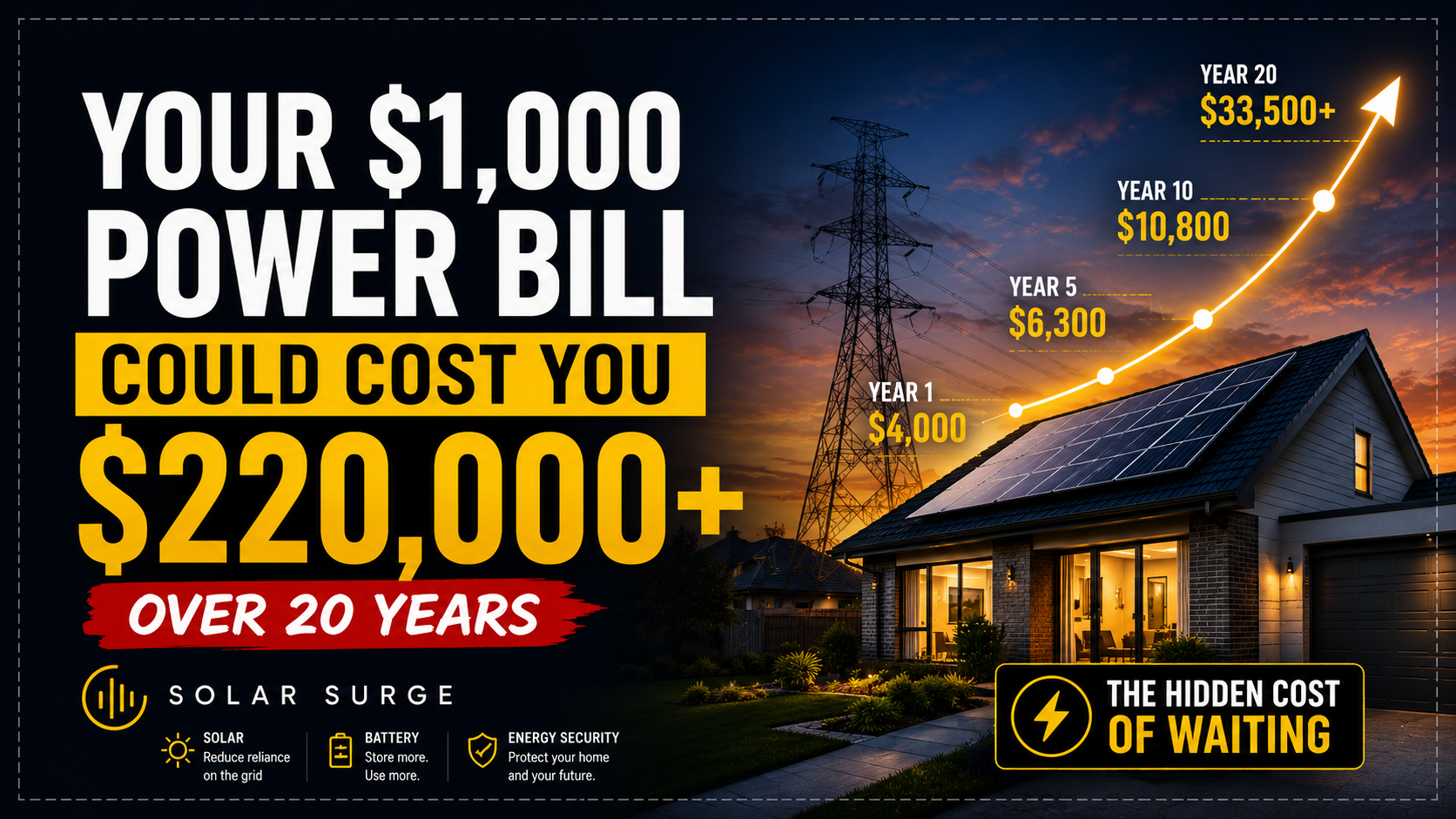
Year 1: $4,000
Year 5: Approximately $6,300
Year 10: More than $10,000
Year 15: Approximately $18,000
Year 20: More than $30,000 per year
Suddenly, the household is paying several times more for electricity than they were when they started.
What looked like an $80,000 expense becomes something much larger.
When all twenty years are added together, total electricity expenditure can exceed $150,000 and, depending on future pricing and consumption patterns, may approach or exceed $220,000.
That’s a staggering amount of money spent simply purchasing electricity from the grid.
The Cost Nobody Calculates
When homeowners consider solar or battery storage, they often focus entirely on installation costs.
The first question is usually:
“How much does it cost?”
While that’s a reasonable question, it’s only half the equation.
A more important question may be:
“How much does doing nothing cost?”
This is where many households get caught.
People delay making decisions because their current electricity bill doesn’t feel painful enough.
They decide to wait another year.
Then another year.
Then another.
Meanwhile, electricity prices continue to rise.
The cumulative cost of waiting is rarely considered.
In many cases, homeowners spend years trying to avoid a large purchase while unknowingly committing themselves to much larger future energy expenses.
The decision to wait may feel like the safer option.
Financially, it may not be.
Why Electricity Costs Matter More Than Ever
Energy is no longer a small household expense.
For many Australian families, electricity has become one of the largest ongoing costs after housing.
Several trends are contributing to this:
Increased Household Consumption
Modern homes use more electricity than ever before.
Large televisions, multiple refrigerators, air conditioning systems, pool pumps, electric cooking appliances, home offices and electric vehicle charging all contribute to higher consumption.
Many households are using significantly more energy than they did a decade ago.
Rising Network Costs
Maintaining and upgrading Australia’s electricity infrastructure requires significant investment.
These costs are ultimately passed through to consumers.
Inflation
Like nearly every industry, energy providers face increasing operating costs.
Inflation impacts labour, materials, maintenance and infrastructure, which can flow through to electricity pricing.
Growing Energy Demand
Australia’s transition toward electrification is increasing demand for electricity.
As more homes adopt electric vehicles and electric appliances, pressure on the grid continues to grow.
These factors create an environment where long-term electricity price stability cannot be assumed.
A Different Way To Think About Energy
Traditionally, homeowners have viewed electricity as something they purchase.
You consume power.
You receive a bill.
You pay the bill.
End of story.
However, solar technology has fundamentally changed that relationship.
For the first time, homeowners have the ability to produce a significant portion of their own electricity directly from their property.
Instead of being solely consumers of energy, they can become producers.
This changes the conversation entirely.
The question shifts from:
“How much will my electricity bill be next quarter?”
to:
“How much power can my home generate over the next 20 years?”
That’s a very different way of thinking.
Why Solar and Battery Systems Are Gaining Attention
The popularity of solar and battery systems isn’t simply about environmental benefits.
For many homeowners, it’s about control.
Energy costs are one of the few major household expenses that can potentially be reduced through technology.
A properly designed solar and battery system may help homeowners:
- Reduce reliance on electricity retailers
- Offset rising energy prices
- Increase self-consumption of generated power
- Improve long-term energy predictability
- Potentially lower ongoing household expenses
Of course, results vary from household to household.
Every home is unique.
Roof orientation, shading, household usage patterns, electricity tariffs and battery suitability all influence outcomes.
That’s why professional assessment and system design are critical.
The Most Expensive Decision May Be No Decision
One of the biggest risks homeowners face is analysis paralysis.
There is always another article to read.
Another battery model to compare.
Another year to wait.
Another electricity bill to pay.
But while homeowners are researching, electricity prices continue moving.
The grid doesn’t pause while people make decisions.
Every month spent waiting is another month of energy purchased at retail rates.
The reality is that doing nothing is still a decision.
And like every decision, it has consequences.
The cost simply arrives gradually, making it less noticeable.
Looking Beyond Today’s Bill
Most people focus on the next electricity bill.
Very few focus on the next twenty years of electricity bills.
Yet that’s where the biggest financial impact exists.
Whether solar and battery storage are right for your home depends on many factors.
But before dismissing the idea, it’s worth understanding the true long-term cost of relying entirely on grid electricity.
Because the real question isn’t whether your current bill is $1,000 per quarter.
The real question is:
How much will you spend over the next twenty years if electricity prices continue rising?
For many Australian homeowners, the answer may be far higher than they ever imagined.
And understanding that number could completely change the way they think about energy, their home, and their financial future.